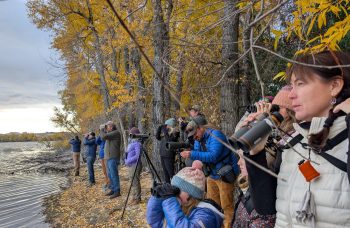
The WWG attendees are exploring Helena’s birding spots with local guides.
From October 21–24, 2025, conservation leaders from across the Western Hemisphere gathered in Helena, Montana, for the Partners in Flight Western Working Group (WWG) Fall Meeting. With over 100 participants joining in person and virtually, the gathering showcased the power of collaboration, science-driven strategies, and community-rooted conservation.
Forests, Fire, and Bird Habitat: Integrated Approaches
The Intermountain West Joint Venture (IWJV) shared updates on their Western Forests Program, emphasizing wildfire risk reduction, forest bird conservation, and relevance to people. Their “fire-bird” spatial tool, developed with the Montana Natural Resources Conservation Service, models how forest treatments impact fire severity and bird habitat. The WWG committed to forming a Community of Practice for Western Forests to advance shared strategies and data integration.
Action Item: Environment and Climate Change Canada will convene a follow-up meeting to gather input and align regional efforts with the Integrated Conservation Framework for Western Forests.
Conservation Without Borders: Strengthening International Partnerships
Sessions on multinational collaboration spotlighted efforts in Mexico, Central America, and Canada. The Sociedad para el Estudio y Conservación de las Aves en México 2025 Congress and the upcoming International Ornithological Congress in Mérida (2026) were identified as key opportunities to strengthen Mexico’s PIF network and cross-border conservation.
Action Item: WWG will continue its engagement strategy for Mexico and Mesoamerica, including support for the National Bird Conservation Strategy in Mexico (ENCA).
Tracking Migration: Expanding the Motus Network
Motus updates revealed rapid expansion across the western U.S., Mexico, and Central America. From Purple Martins to Olive-sided Flycatchers, partners are deploying tags and building infrastructure to understand full annual cycle movements.
Action Items:
- Launch webinars on Motus data use and analysis.
- Develop a funding strategy to support orphaned stations and future-proof the network.
Tools for Conservation: AKN, ACAD, and Beyond
The Avian Knowledge Network (AKN) and Avian Conservation Assessment Database (ACAD) vulnerability scores were discussed as essential tools for data integration and decision-making. WWG members emphasized the need for clearer branding and streamlined workflows between platforms and state heritage databases.
Action Item: Formalize a funding and marketing strategy for AKN and ACAD, including cooperative agreements and internal support.
Species Spotlights: Lewis’s Woodpecker and More
Research on Lewis’s Woodpecker by MPG Ranch and Fogarty Lab revealed critical insights into post-fire habitat use and migration patterns. Passive acoustic monitoring and Motus tagging are helping fill data gaps for species such as Western Wood-Pewee and Olive-sided Flycatcher.
Action Item: Continue collaborative monitoring and explore scalable models for forest bird conservation.
Looking Ahead
The WWG Executive Committee announced that the next meeting will be in Salt Lake City, Utah, on April 20th – 24th. As we move toward 2026, WWG will focus on cross-pollination with Joint Ventures, mentorship development, and storytelling tools to communicate impact.
We’re grateful to all who participated and shared their expertise. Together, we’re building a resilient, inclusive, and science-driven future for birds and the habitats they depend on.
Want to Help?
The WWG is seeking individuals passionate about these topics to join us in advancing these action items. If you would like to participate in any of these action items, please reach out to committee chair Adam Brewerton adambrewerton@utah.gov.