PIF Science Special Feature Series
Partners in Flight (PIF) Science Committee currently has over 10 manuscripts in review for a Special Feature in Avian Conservation and Ecology featuring the committee’s migratory bird conservation tools and applications. The Special Feature’s opening essay was published in late January 2026 and outlines PIF’s history, broad direct and indirect impacts, and PIF Science’s call to action to come together across the bird conservation community.
Since 1990, Partners in Flight (PIF) has catalyzed a paradigm shift from an exclusive focus on hunted and endangered bird species toward a collaborative, hemispheric, science-based approach to reversing declines in nongame migratory birds. As billions of birds continue to be lost from the North American avifauna we need a more targeted approach to recovering bird populations and increased efforts to protect and restore healthy ecosystems. The opening essay in Avian Conservation and Ecology lays out both a proud legacy and an urgent charge: PIF’s collaborative science has reshaped conservation practice, but the scale of loss demands sharper alignment, faster action, and broader inclusion.
PIF’s impact is practical and measurable. Its flagship tools, the Avian Conservation Assessment Database (ACAD) and the Population Estimates Database (PED), along with regional plans and standardized monitoring, are decision‑support resources used by federal and state agencies, Migratory Bird Joint Ventures, and conservation organizations to set priorities and measure outcomes. The paper’s Cerulean Warbler case study illustrates how coordinated assessment, species working group efforts, targeted management, and international investment can translate into on‑the‑ground gains for a declining migratory species, showing that applied, cross‑border science leads to conservation wins.
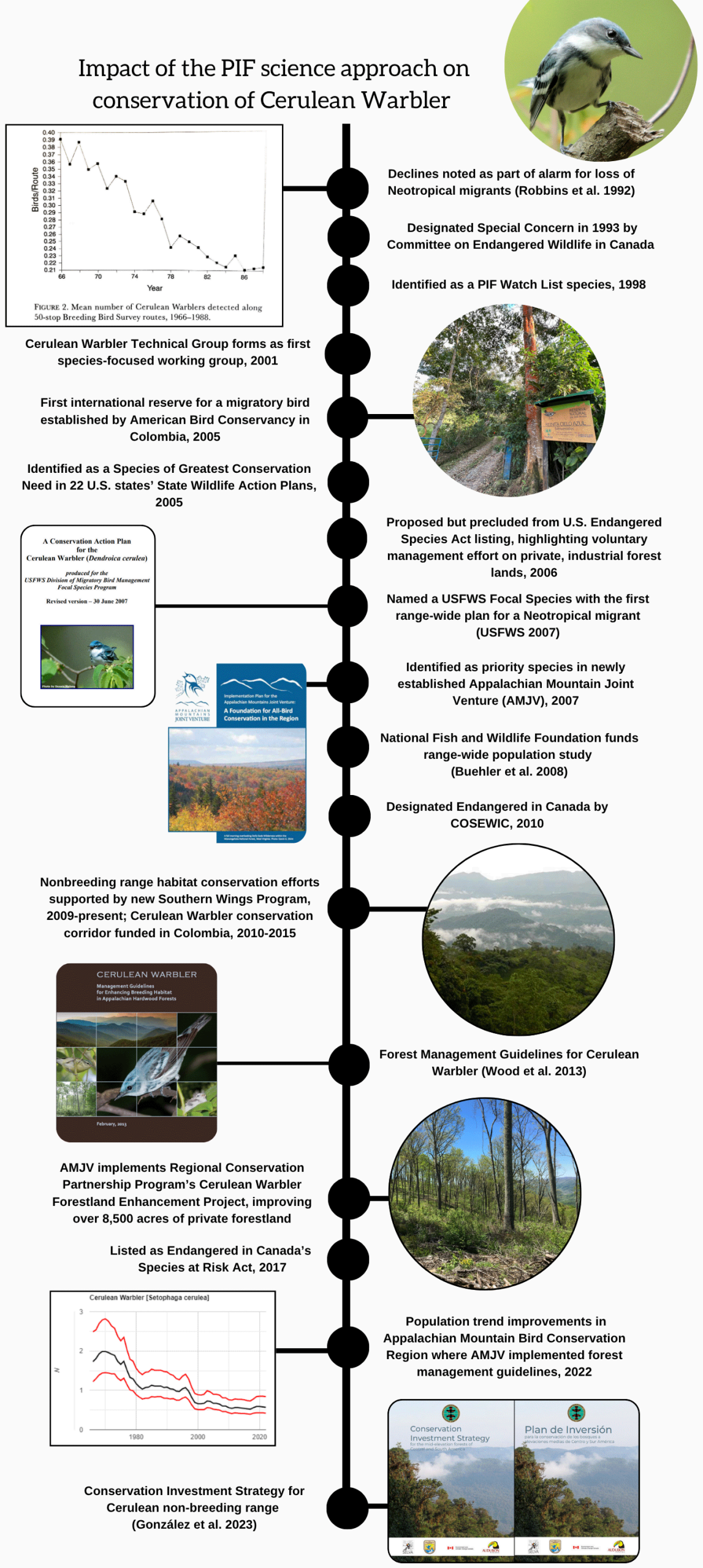
Fig. 1. Long-term impact of Partners in Flight’s (PIF) collaborative science approach; a case study of conservation for Cerulean Warbler (Setophaga cerulea). Photos: Cerulean Warbler, Ken Rosenberg; Trend graph, Robbins et al. 1992; International reserve, American Bird Conservancy; Colombian conservation corridor, American Bird Conservancy; Forest management, Todd Fearer; Breeding Bird Survey trend graph, Sauer et al. 2022.
The authors call for a renewed, collaborative applied‑science agenda: to support the integration of social and biological science, elevate partners in the Global South, increase Indigenous engagement and the weaving of Indigenous knowledge with Western science, and empower next‑generation leaders. There is a need to continue improving partner communication so organizations can focus on a niche while also contributing to a broad, unified conservation strategy. The message is clear: partners must work in concert if we are to reverse steep declines and keep common birds common.
There are simple ways to help amplify this work and promote synergy across our community: share the ACE Special Feature and its science briefs, support timely media outreach that translates technical findings into conservation action, and encourage your agency or organization to clarify its niche within the broader bird-conservation network. Watch for upcoming papers in the PIF Special Feature that unpack ACAD, PED, population objectives, and social‑science approaches, and join the conversation to help turn this urgent vision into measurable recovery.
Partners in Flight
Partners in Flight (PIF) is a dynamic and welcoming network of more than 150 partner organizations distributed throughout the Western Hemisphere. PIF is engaged in all aspects of landbird conservation from science, research, planning, and policy development, to land management, monitoring, education, and outreach. The mission of PIF is keeping common birds common and helping recover species at risk through voluntary partnerships. The PIF International Science Committee is an open forum of scientists dedicated to advancing scientific concepts and approaches for landbird conservation at range-wide and regional scales. The focus of this special issue is to provide perspectives on successful collaborative approaches undertaken under the PIF umbrella, feature analyses to target bird conservation efforts, and to describe the methods and conservation applications of PIF Science’s flagship tools: the Avian Conservation Assessment Database and Population Estimates Database.
As the special features are published, they can be found on the Avian Conservation & Ecology website.